When Should You Start Studying For The BCBA Exam?
Most people start seriously preparing for the BCBA exam somewhere in the last two or three months before they sit it. Fieldwork first, studying afterwards, in that order, because that is the order the requirements are listed in.
Start earlier and lighter instead, and start while you are still accruing fieldwork hours. Two things make that the better plan: the research on spaced practice consistently favours spreading the same study time across a longer period, and at least 60% of your supervised fieldwork has to be spent on unrestricted activities, which are the same activities the exam asks you about. Treating fieldwork and exam prep as separate phases wastes the overlap.
You are in fieldwork longer than you think
The BACB requires 2,000 hours of supervised fieldwork, or 1,500 hours of concentrated supervised fieldwork with a higher supervision requirement: 5% of hours for the standard route and 10% for the concentrated one. Trainees must accrue no fewer than 20 and no more than 130 hours in any calendar month.
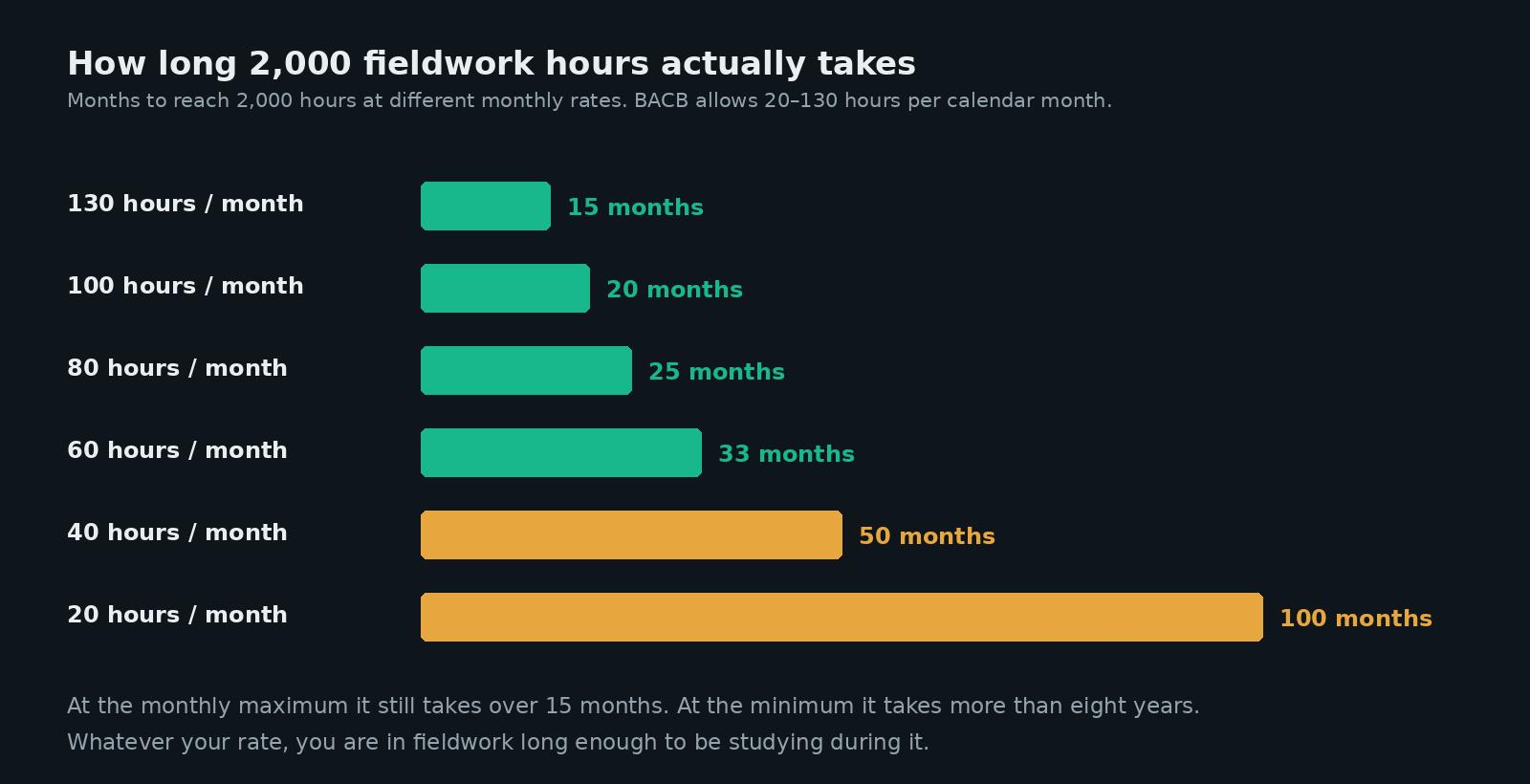
Even at the monthly maximum, 2,000 hours takes more than 15 months. At 60 hours a month it is closer to three years. Whatever your pace, you are going to be in fieldwork for a long stretch, and that stretch is the window almost everybody leaves empty.
Try this: work out how many hours a month you are actually logging and divide. That number is how long you have, and it is almost certainly longer than the three months you were planning to study in.
Earlier and lighter beats later and heavier
This is not a motivational point, it is a finding. Rohrer and Pashler found sharp declines in performance among people who massed their practice compared with people who spread the same amount across sessions. Same total hours, different distribution, worse outcome for the compressed version.
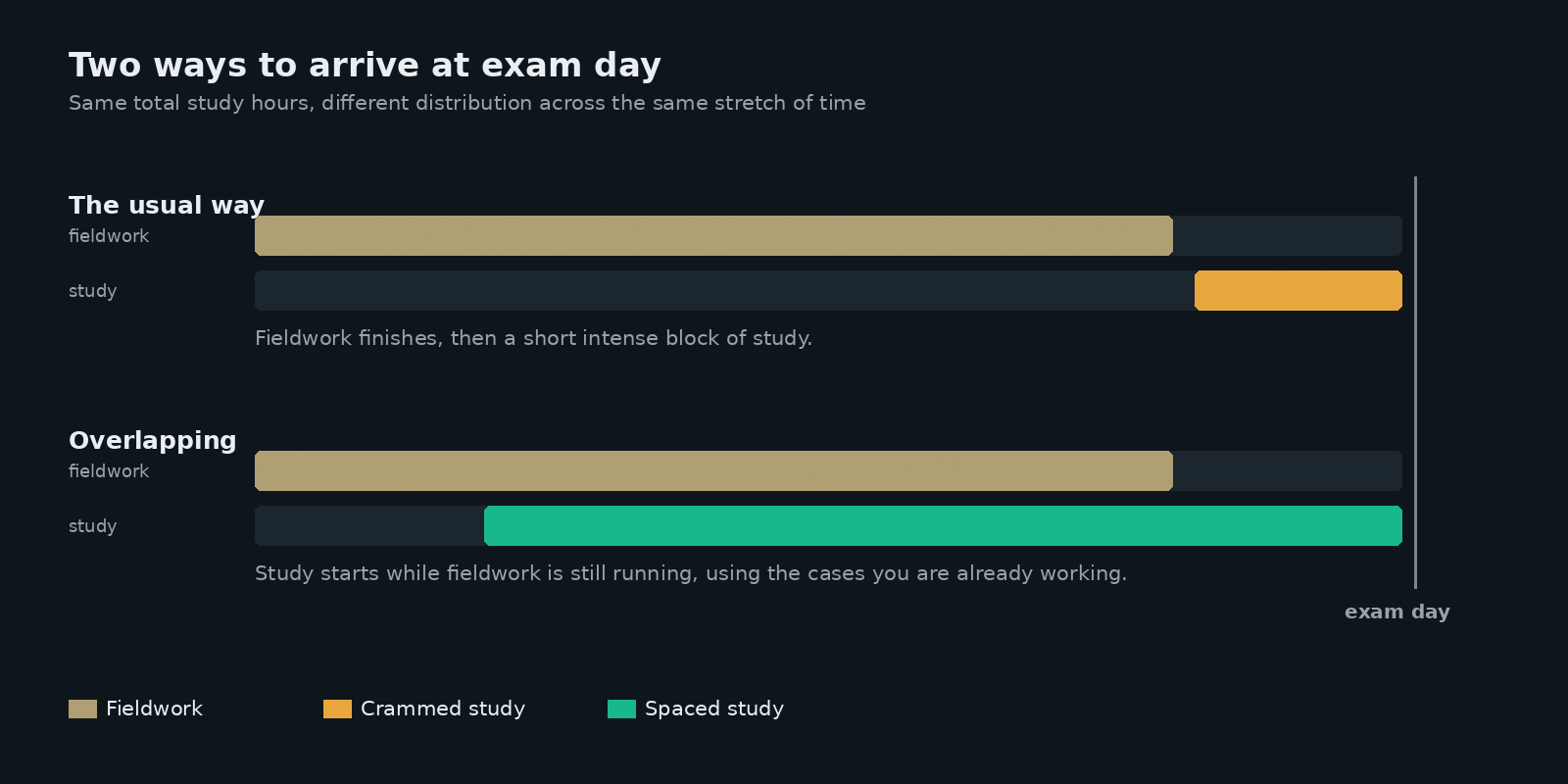
Applied here: thirty minutes four times a week across a year is a far stronger preparation than the same total hours packed into the eight weeks before your date. It is also easier to sustain alongside a job, which matters more than it sounds: the plan you actually follow beats the plan that looks better on paper.
The catch is that light, early study feels like doing nothing. There is no visible progress, no sense of a deadline, nothing to point at. That is the main reason people postpone it, and it is not a good reason.
Try this: put three or four short sessions a week in your calendar now, at whatever stage of fieldwork you are in. Thirty minutes is enough. Consistency is doing the work, not duration.
Most of your fieldwork is already exam content
Here is the part that gets missed. The BACB requires that at least 60% of supervised fieldwork be spent on unrestricted activities: assessment, programme design, data analysis, supervision, caregiver training. Those are not adjacent to the exam. They are the exam.
On the 2,000-hour route, 60% is at least 1,200 hours of doing precisely the things the questions describe. And the exam asks what you would do in a situation, not what a term means, which makes lived cases the single best study material available to you. You cannot buy this. Everyone who has already passed had it and most of them did not use it deliberately.
The gap is that fieldwork happens in ordinary language and the exam happens in technical language. You run a preference assessment; the question calls it a paired-stimulus preference assessment and asks which arrangement suits a client who tends to select the same item repeatedly. Same thing, different register. Translating between the two is the work.
Try this: after each session, write two or three sentences naming what happened in technical terms. What was the function, what was the contingency, what would you have done differently. Five minutes, and it converts work you are doing anyway into exam preparation.
What "starting" looks like at each stage
Starting early does not mean sitting practice exams for two years. What you should be doing changes as you go.
| Where you are | What studying looks like |
|---|---|
| Early fieldwork | Vocabulary and concepts. After each session, name what you saw in technical terms. No practice exams yet. |
| Mid fieldwork | Retrieval practice on one area at a time, then mixed sets once the basics hold. Start writing your own scenarios from real cases. |
| Late fieldwork | Full-length timed practice exams. Accuracy by content area decides where the remaining time goes. |
| Final month | No new material. Consolidate weak areas, keep sitting timed sections, protect your sleep. |
The order matters. Practice exams taken far too early mostly tell you that you have not learned the material yet, which you already knew, and they burn through questions you could have used later when the information would have been worth something.
Try this: match the activity to the stage. Early on, translate sessions into technical language. Later, test yourself. Save full-length timed exams for when they can actually change your plan.
When to book the date
Your two-year authorization period starts when your application is approved, and you get eight attempts inside it. That clock is generous enough not to panic about and short enough not to ignore.
The mistake is booking the earliest date you are eligible for, because eligibility feels like a starting gun. It is not. Work backwards instead: decide what preparation you need, count the weeks, and book accordingly. A date chosen for its own sake becomes a deadline your preparation has to fit around rather than the other way round.
There is no officially recommended study period. Nobody publishes one, and anyone quoting a specific number of months is describing their own experience or inventing it.
Try this: take a diagnostic before you book anything. Booking a date without knowing where you stand is how people end up sitting the exam a month too early.
Frequently asked questions
How long should you study for the BCBA exam?
There is no official recommendation. The research on spaced practice favours spreading study across months rather than compressing it into weeks, so a longer period with shorter sessions generally beats a short intense block using the same total hours.
Can you study for the BCBA exam while doing fieldwork?
Yes, and it is the better approach. At least 60% of supervised fieldwork must be unrestricted activities, which are the same activities the exam tests, so fieldwork provides case material no study guide can match.
How many fieldwork hours do you need to become a BCBA?
2,000 hours of supervised fieldwork, or 1,500 hours of concentrated supervised fieldwork. The standard route requires supervision of 5% of hours and the concentrated route 10%.
How many fieldwork hours can you do per month?
No fewer than 20 and no more than 130 hours in a calendar month, according to the BACB. At the maximum, 2,000 hours takes just over 15 months.
When should you book your BCBA exam date?
After you know where you stand, not as soon as you are eligible. Your two-year authorization period gives you eight attempts, so work backwards from the preparation you need rather than forwards from your eligibility date.
Is three months enough to study for the BCBA exam?
It can be, but it is the compressed version of a plan that works better spread out. If three months is what you have, protect the spacing within it: short frequent sessions beat long weekend blocks even inside a short window.
Where to start
If you are mid-fieldwork right now, start with the five-minute habit: after each session, write down what happened in technical terms. It costs almost nothing and it is the single highest-return thing available to someone who is not yet eligible to sit the exam.
Everything else (the practice questions, the timed mocks, the weak-area work) can wait until it will tell you something. That habit cannot, because the sessions it draws on are happening now and will not come back.
Starting early only helps if you know what to work on. Beacon's free diagnostic scores you by content area even if you are months from eligible, so the studying you do during fieldwork goes where it is needed.
The research behind this
- BACB BCBA Handbook: supervised fieldwork hours, supervision percentages, unrestricted activity requirement and monthly limits.
- BACB on continual testing: attempts and the authorization period.
- Rohrer & Pashler (2007), on spacing versus cramming.
- Karpicke, Butler & Roediger (2009), on how students actually study, Memory 17(4).