5 Study Habits To Pass The BCBA Exam
You have a date booked, a stack of material, and a nagging sense that you are working hard without getting anywhere. Most people preparing for the BCBA exam are not short on effort. They are spending it on methods that feel productive and do very little.
The five study habits with the strongest research behind them are: test yourself instead of rereading, spread your sessions across weeks instead of stacking them, mix domains within a session, aim your time at your weakest areas, and practice with scenarios instead of definitions. Every one of them feels worse than what it replaces, which is exactly why most people do not do them.
That gap between how studying feels and what it does has a name. Researchers call it the illusion of fluency: material you have just read feels familiar, and familiarity gets mistaken for knowing. But familiar only means you will recognize it when you see it, and the BCBA exam never asks you to recognize anything. It hands you a situation and asks what you would do.
1. Test yourself instead of rereading
Rereading is the most popular study method there is, and one of the least effective.
When Karpicke, Butler and Roediger asked students how they study on their own, rereading came first by a wide margin, and only a small minority tested themselves at all. The few who did mostly used it to check what they had already learned, rather than as the way they learned it. That ranking is backwards. Reviews of classroom research keep finding that answering questions beats rereading, and the advantage is widest against exactly the methods students prefer — rereading and highlighting.
Rereading feels better because it is easier. Pulling an answer out of your head takes effort and you get things wrong, which feels like failure. It is not. The effort is the part that works.
One warning, because it is the most common way people think they are doing this and are not: working through practice questions with the rationale visible is still rereading. You have to commit to an answer before you look.
Try this: close the material and answer from memory. After reading about reinforcement schedules, write down what each one produces before you check anything. Whatever you could not produce is your actual study list.
2. Spread your studying across weeks
Six hours on a Saturday feels like real work. The same six hours spread across three weeks does not. The second one works considerably better.
Rohrer and Pashler found sharp declines in performance among people who massed their practice compared with people who spread the same amount across sessions. The total study time is identical. Only the distribution changes.
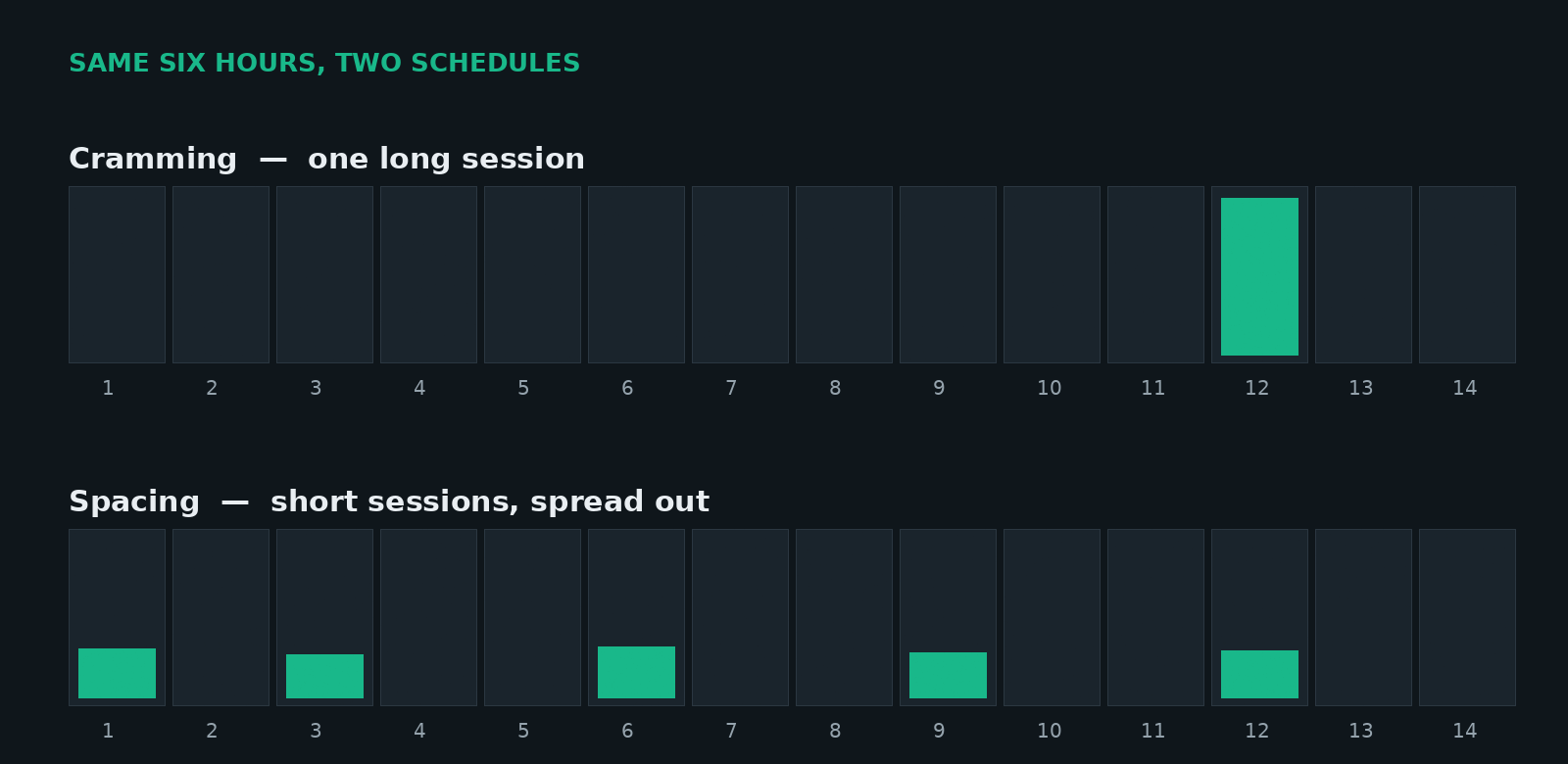
Cramming survives because it does work, briefly. You will do well on something you sit immediately after a long session. What it will not do is hold. Letting material fade slightly and then pulling it back is what strengthens it, and cramming never lets anything fade.
This is also the habit that decides how early you should start. If your plan depends on long weekend sessions in the final month, the plan is the problem, not your discipline.
Try this: shorter sessions, more often. Four thirty-minute sessions across a week beat one two-hour block, and the material is still there a month later. Put them in the calendar rather than deciding each day.
3. Mix the domains within a session
Most study plans go domain by domain. Measurement this week, ethics next week, experimental design after that. It feels organized. It also trains the wrong skill.
When you work through twenty measurement questions in a row, you already know the answer involves measurement before you read the question. The hardest part of the real exam — working out what kind of problem you are even looking at — has been removed for you. Taylor and Rohrer found that mixing problem types together produced substantially better results than practicing them in blocks, even though the blocked group performed better during practice.
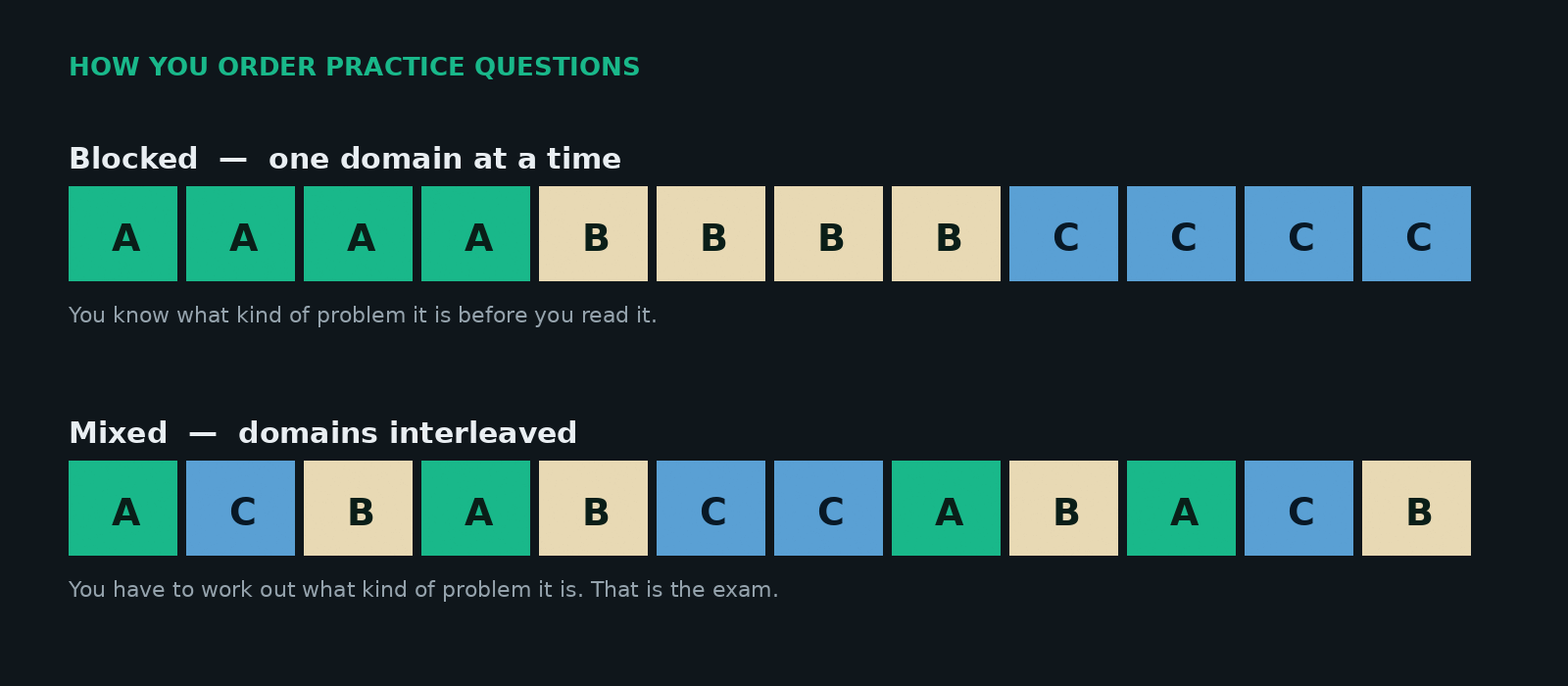
That last detail is the catch. Blocked practice looks better while you are doing it, which is why it feels right, and why how a session went is a poor guide to whether it worked.
Blocking still has one honest use: the first time you meet an area, study it on its own until the basics hold. After that, stop.
Try this: build mixed sets once you know the basics of an area. Your accuracy will drop compared with blocked practice — that drop is the point, because it is what the exam feels like.
4. Aim at your weakest two areas
Look at where your study time actually goes. For most people it piles up in the areas they already handle well.
That is not laziness. It is the same illusion working at the level of a schedule. Strong areas feel good to review: you get answers right, the session feels productive, you finish encouraged. Weak areas feel bad. So the plan quietly drifts toward the comfortable material, and the drift is invisible because every individual session felt fine.
The areas people avoid most are the ones that need interpretation rather than recall — experimental design, and the measurement content involving graphs. You cannot memorize your way through a graph. You have to read level, trend and variability and say what they mean, and that only comes from doing it badly for a while first.
Koriat and Bjork showed how poorly people judge their own learning, and the error runs in one direction: confident about material that merely feels familiar. Which means your sense of where you are weak is not reliable on its own — it needs something to check it against.
Try this: take a diagnostic, look at accuracy by area, and give the bottom two your next two weeks. You will not enjoy it. That is the correct reaction to studying something you are bad at.
5. Practice with scenarios, not definitions
You can define negative reinforcement. Can you read four sentences about a teacher, a student and a task demand and identify the contingency?
Those are different skills, and only the second one is tested. This matters more than it used to: the exam has moved further toward application and judgment, and that shift is one of the reasons commonly given for falling pass rates. Preparation built on recall is preparing for a version of the exam that no longer exists.
Ethics is the clearest case. The code itself is memorizable, but questions describe situations where more than one option looks defensible and ask which is most appropriate. Knowing the code is necessary and nowhere near sufficient.
Definitions are where studying starts, not where it stops. Flashcards give you the vocabulary. They do not give you the judgment.
Try this: for every concept, build a scenario out of your own fieldwork. You have sat in sessions where these principles were running. A concept you have personally watched play out with a real client is one you will not lose under time pressure.
The short version
| What feels productive | What actually works | Why |
|---|---|---|
| Rereading your notes | Answering questions from memory | Recognition is not recall |
| One long weekend session | Short sessions across weeks | Material has to fade before it strengthens |
| One domain at a time | Domains mixed together | The exam never tells you the category |
| Reviewing your strong areas | Working your weakest two | Comfort is not progress |
| Memorizing definitions | Working through scenarios | The exam asks what you would do |
Frequently asked questions
How long should I study for the BCBA exam?
There is no single right answer, but the research on spacing points clearly toward months rather than weeks. The same number of study hours produces better retention spread across a longer period, so starting earlier and studying less each day beats starting late and studying hard.
Is it better to study every day or do long sessions?
Shorter sessions more often. Four thirty-minute sessions across a week outperform a single two-hour block using the same total time, because the gaps between sessions are what make material stick.
Should I study one domain at a time?
Only when you first meet an area. Once you know the basics, mix domains within the same session — practicing one domain at a time removes the work of identifying what kind of problem you are looking at, which is a large part of what the exam actually tests.
Do flashcards work for the BCBA exam?
They work for vocabulary and they are a genuine form of self-testing, which is habit one. They do not prepare you for scenario questions, so treat them as a starting point rather than a study plan.
How do I know which areas I am weakest in?
Not by intuition — research on self-assessment shows people are consistently overconfident about material that feels familiar. Use results from a diagnostic or practice exam broken down by domain, and let that pick your schedule.
Why does studying that feels productive not work?
Because ease and learning pull in opposite directions. Methods that feel smooth — rereading, cramming, blocked practice — produce fluency in the moment without building durable recall, while the methods that feel harder are the ones that last.
Where to start
Pick one. Not five — people who overhaul everything at once tend to be back in a month having changed nothing.
If you only change one, make it the first. Stop rereading and start answering from memory in your next session. It has the widest gap between how productive it feels and how much it does, and the only thing it costs you is finding out what you do not know yet.
If you are reading this after a failed attempt, the retake has a problem of its own on top of these five: why the second attempt is harder.
Not sure which areas are your weakest? Beacon's free diagnostic gives you accuracy by domain in about twenty minutes, so habit four has something to point at. From there, every practice exam is built fresh and retakes are free.
The research behind this
- Karpicke, Butler & Roediger (2009), on how students actually study — Memory 17(4).
- Jaeger et al. (2019), review of retrieval practice in classrooms — Frontiers in Education.
- Rohrer & Pashler (2007), on spacing versus cramming.
- Taylor & Rohrer (2010), on interleaved practice — Applied Cognitive Psychology 24(6).
- Koriat & Bjork (2006), on illusions of competence while studying.