How Many Questions Can You Get Wrong And Still Pass The BCBA Exam?
It is one of the most searched questions about the BCBA exam, and the internet will give you a confident answer. You will read that you need around 76%, or that you can miss roughly 45 questions, or that the cut-off is 92 out of 175.
None of those numbers come from the BACB, and there is no fixed number of questions you can get wrong. The passing standard is set separately for each examination form using expert judgment, scores are then placed on a scale rather than reported as raw counts, and the BACB states plainly that it will not report how many questions you answered correctly. The number does not exist in the form people are looking for.
Where the numbers online come from
Mostly from each other. A figure appears on one prep site, gets quoted by a second, and by the fifth it has the confidence of established fact without anyone having a source. If you follow any of them back, the trail stops at another blog.
That matters more than it sounds. If you set out to score 76%, you are aiming at a target nobody has confirmed exists, and you will calibrate your preparation, how hard to push, when to stop, when to book, against a number somebody invented.
Try this: when you see a specific passing percentage for the BCBA exam, look for the source. If it is not a BACB page, treat the number as decoration.
How the passing standard is actually set
The BACB uses what it calls the modified Angoff method for establishing the passing score for each base examination form.
In broad terms, that means a panel of subject-matter experts reviews the questions and judges, for each one, how a minimally qualified candidate would be expected to perform. Those judgments are combined into a standard for that form. The standard reflects what the experts consider competent practice, not how many people happened to do well that year.
Two consequences follow, and they are the whole answer to the question in the title. First, the standard is tied to a specific form, so a form with harder questions carries a different raw requirement from one with easier questions. Second, the standard is about competence rather than ranking, which is why the exam is criterion-referenced and not curved. You are not competing with the other people in the testing centre.
Try this: stop thinking of the exam as a percentage to clear and start thinking of it as a standard to meet. The distinction changes what you study: breadth across all nine areas rather than points in your best ones.
Why your score is scaled
Because different forms carry different standards, raw counts are not comparable between candidates. So the BACB transforms them. In its own words, scaled scores are created when the number of questions answered correctly is "mathematically transformed so that the passing score equals a certain point on a scale".
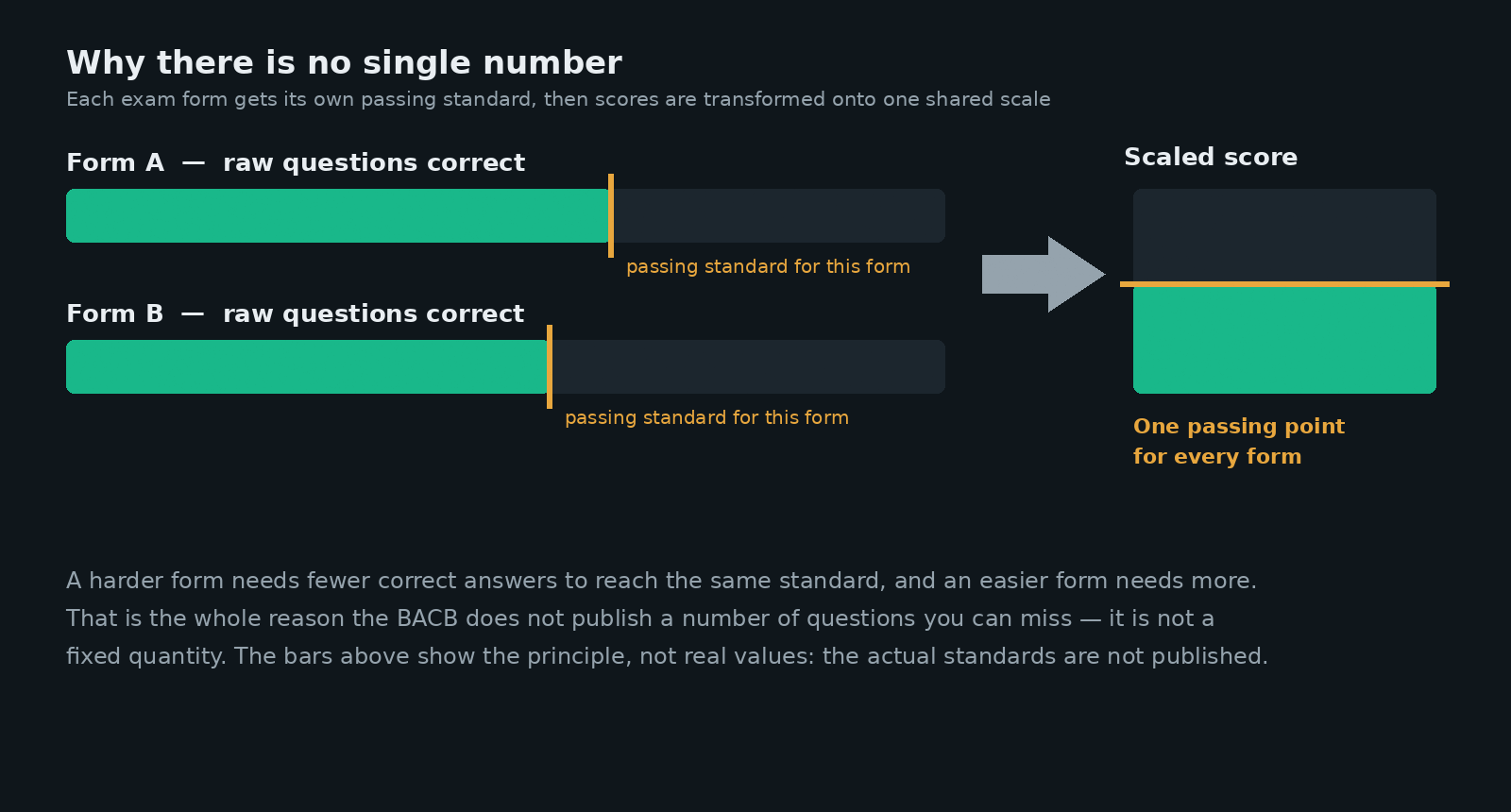
That is why the question has no stable answer. A harder form needs fewer correct answers to reach the same standard, and an easier one needs more. Any single number would be wrong for most forms, which is presumably part of why the BACB does not publish one.
It is also why the BACB states it "will not report the number of questions answered correctly or the overall percentage of questions answered correctly". The raw figure would invite exactly the comparison the scaling exists to prevent.
What you are actually told afterwards
This part surprises people. If you pass, you receive notice that you passed, and nothing else. No score, no breakdown, no sense of whether you cleared the standard comfortably or by a hair.
If you fail, you receive a report showing the percentage of questions you answered correctly within each primary content area.
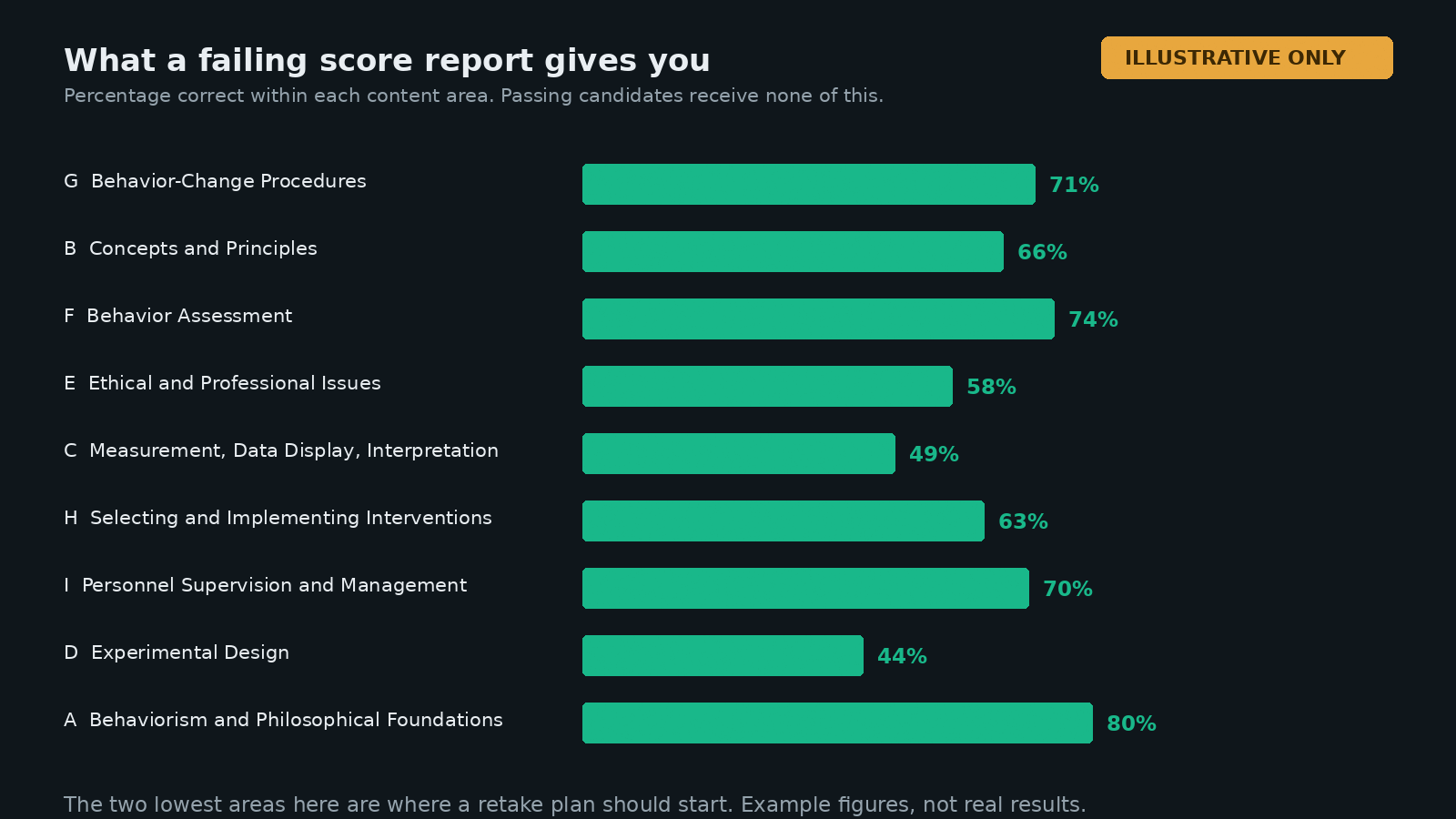
So the only detailed, personal information the system produces about your performance goes to candidates who did not pass. If you are in that position, that report is the most useful document you own, and it should drive your entire retake plan rather than sitting in an inbox.
Try this: if you have a failing report, rank the content areas from it and give the bottom two the majority of your next study block. It is the only genuinely personalised data the exam will ever give you.
Not everything on the exam counts
One more reason the arithmetic people attempt does not work: the exam contains 175 scored questions and 10 unscored pilot questions, according to the BACB Test Content Outline. Pilot items are being trialled for future use and are indistinguishable from the rest while you are sitting there.
So even if a fixed raw threshold existed, ten of the questions you answered would not be part of it, and you would have no idea which ten. Counting how many you think you missed is a wasted exercise in a more fundamental way than most people realise.
What the sources actually say
| What you will read online | What the BACB actually says |
|---|---|
| "You need about 76% to pass" | No passing percentage is published. Scores are scaled, not raw. |
| "You can miss around 45 questions" | The number of questions answered correctly is never reported. |
| "The passing score is the same every time" | A passing standard is established for each base examination form. |
| "You get a score report showing your percentage" | Only if you fail. Passing candidates are told only that they passed. |
| "All 185 questions count" | 175 are scored. 10 are unscored pilot questions. |
| "It is graded on a curve" | It is criterion-referenced. You are measured against a standard, not against other candidates. |
What to aim at instead
If there is no number, what do you optimise for? Consistency across all nine content areas.
A standard-setting process built on expert judgment about competent practice rewards someone who is solid everywhere and punishes someone who is excellent in three areas and hollow in two. A percentage target encourages the opposite: bank easy points where you are already strong and hope the rest averages out.
The areas are not equally weighted either, so "everywhere" does not mean "equally". Behavior-Change Procedures carries 25 scored questions; Behaviorism and Philosophical Foundations carries 8. Weight your time by what the exam weights, then bias toward wherever you are weakest.
Try this: take a full-length practice exam, look at accuracy by content area, and name your two weakest. That comparison is more actionable than any passing percentage would have been.
Frequently asked questions
How many questions can you get wrong and still pass the BCBA exam?
There is no published number. The passing standard is set for each examination form using the modified Angoff method, and the BACB does not report how many questions candidates answer correctly, so no fixed count exists.
What is the passing score for the BCBA exam?
The BACB reports a scaled score rather than a raw score or percentage, and does not publish a passing percentage. Scaled scores are transformed so that the passing standard sits at a fixed point on the scale.
Is the BCBA exam graded on a curve?
No. It is criterion-referenced, meaning you are measured against a standard of competence rather than against how other candidates performed on the same day.
Do you find out your score on the BCBA exam?
Only in part. Passing candidates are told they passed and receive no further report. Failing candidates receive percentages correct within each primary content area.
Are all 185 questions on the BCBA exam scored?
No. 175 are scored and 10 are unscored pilot questions, according to the BACB Test Content Outline. You are not told which is which.
Why do different websites give different BCBA passing percentages?
Because none of them are sourced from the BACB. The figures circulate between prep sites and are repeated until they look authoritative, but the BACB does not publish a passing percentage.
Where to start
Let go of the number. It is the most natural question to ask and the least useful one to organise around, and the effort it absorbs is effort not spent on the thing that actually decides the outcome.
Find your weakest two content areas and work on those. That is the version of this question you can actually answer.
You cannot chase a number the BACB does not publish. What you can do is find the areas where you are weakest and close them. Beacon's free diagnostic scores you by content area, weighted the way the real exam is weighted.